A Session in 60 Seconds
A coordination session has a birth, a lifetime and exactly one way to end well. One real transcript, message by message, then the five states and the move that is not allowed.
By Ajit Koti
Last time I said that in MACP, binding agreement happens only inside a session. That is easy to say. This post shows what one looks like.
The spec repository ships an illustrative transcript of a Decision Mode session, examples/decision-mode-session.json. It is the same shape as the payments story from the first post: a checkout service, a fraud agent, a growth agent and a compliance agent, deciding what to do about a high-value transfer. It is ten messages long, and it is worth reading one message at a time.
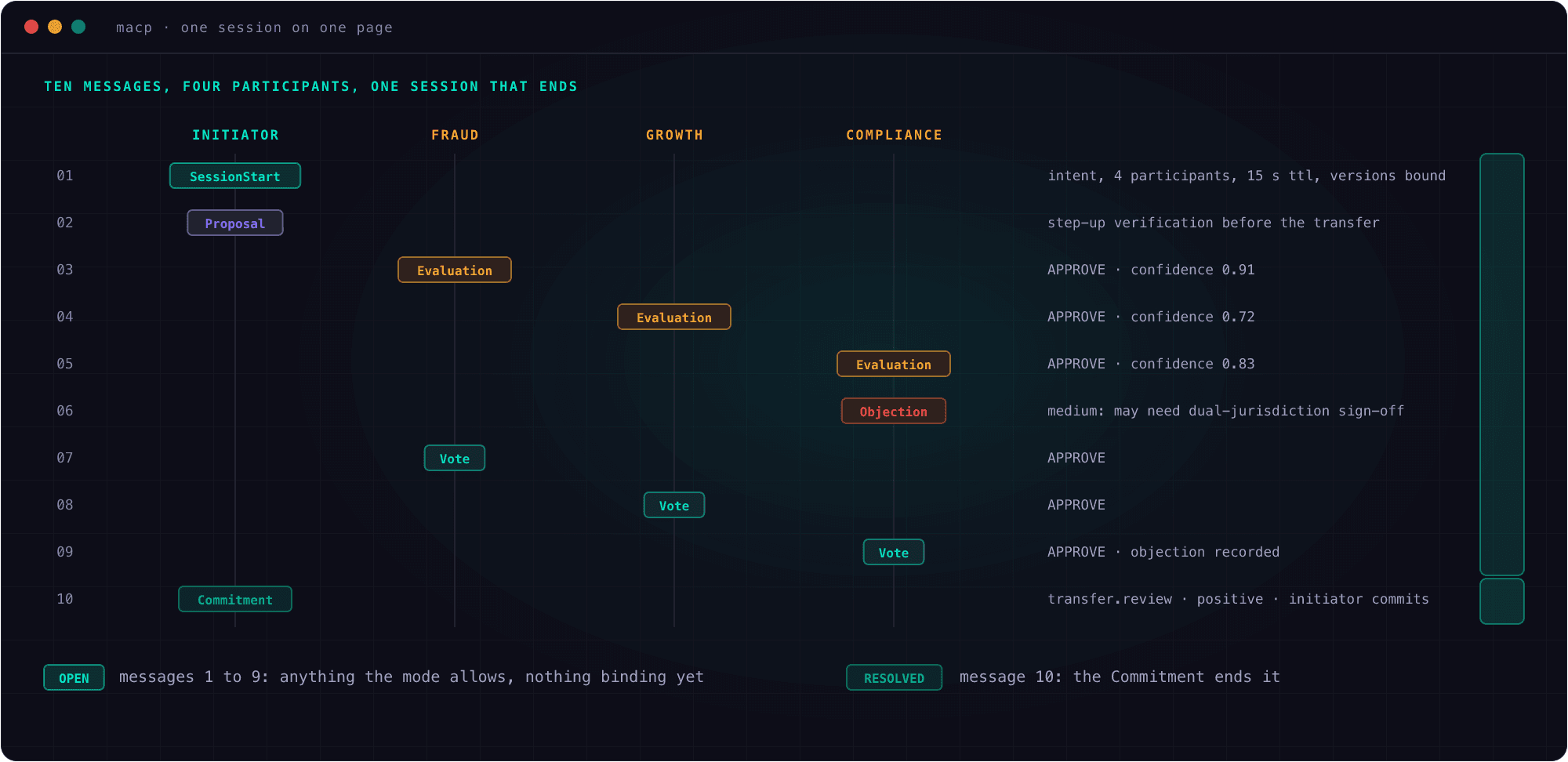 An illustrative decision-mode transcript from the spec repository: nine messages while OPEN, one Commitment to RESOLVE.
Ten messages
1. SessionStart. The checkout orchestrator opens the session. Its intent is "evaluate high-value transfer". It declares four participants (itself, fraud, growth and compliance), a time limit of 15 seconds, and the mode, configuration and policy versions that will govern the session. Those versions are bound here, at the start, and do not change while the session runs. From this moment the session is OPEN.
2. Proposal. The orchestrator puts one option on the table: require step-up verification before the transfer goes through.
3 to 5. Evaluations. Each participant gives its view of the proposal, with a recommendation, a confidence and a reason. Fraud approves at 0.91 (an unusual login time and a jump in location). Growth approves at 0.72 (the customer's history is strong, and a step-up keeps the experience recoverable). Compliance approves at 0.83 (a cross-border rule needs step-up verification before release).
6. Objection. Compliance also raises a medium-severity objection: the transfer is over a single-jurisdiction threshold, so a dual-jurisdiction sign-off may be needed. An objection is not a veto. It is a dissent on the record, attached to the proposal, that anyone reading the session later will see.
7 to 9. Votes. All three vote to approve. Compliance's vote says it in plain words: objection recorded, but step-up verification adequately addresses the concern.
10. Commitment. The orchestrator, as the session's initiator, emits the Commitment: action transfer.review, a positive outcome, and a reason. In Decision Mode the initiator is the default commitment authority unless policy names another. The session is now RESOLVED, and it will not accept anything else.
That is the whole thing. Everyone's position is there, in order, attributed and unchanged. The dissent is on the record. And the outcome is one message, from the party allowed to send it, under rules whose versions were fixed at the start.
A few things in this transcript are easy to miss.
- Who sent each message is not up to the message. In MACP the sender is the authenticated identity of whoever sent it, as established by the runtime. It is not a field an agent can fill in with someone else's name.
- The mode decides what is legal. Decision Mode defines proposals, evaluations, objections, votes and the commitment, and who may send each. A different mode, such as Task or Quorum, has a different set of messages and a different idea of what "done" means.
- The history is append-only. Accepted messages are added in order and never rewritten. That is what makes the session something you can replay.
Five states
The transcript only shows two states, OPEN and RESOLVED. The full lifecycle has five:
- OPEN: accepting the messages the mode allows.
- SUSPENDED: paused. Not an ending.
- RESOLVED: ended with a commitment.
- EXPIRED: ended because time ran out.
- CANCELLED: ended because it was cancelled.
The last three are terminal. Once a session is in one of them, nothing moves it again.
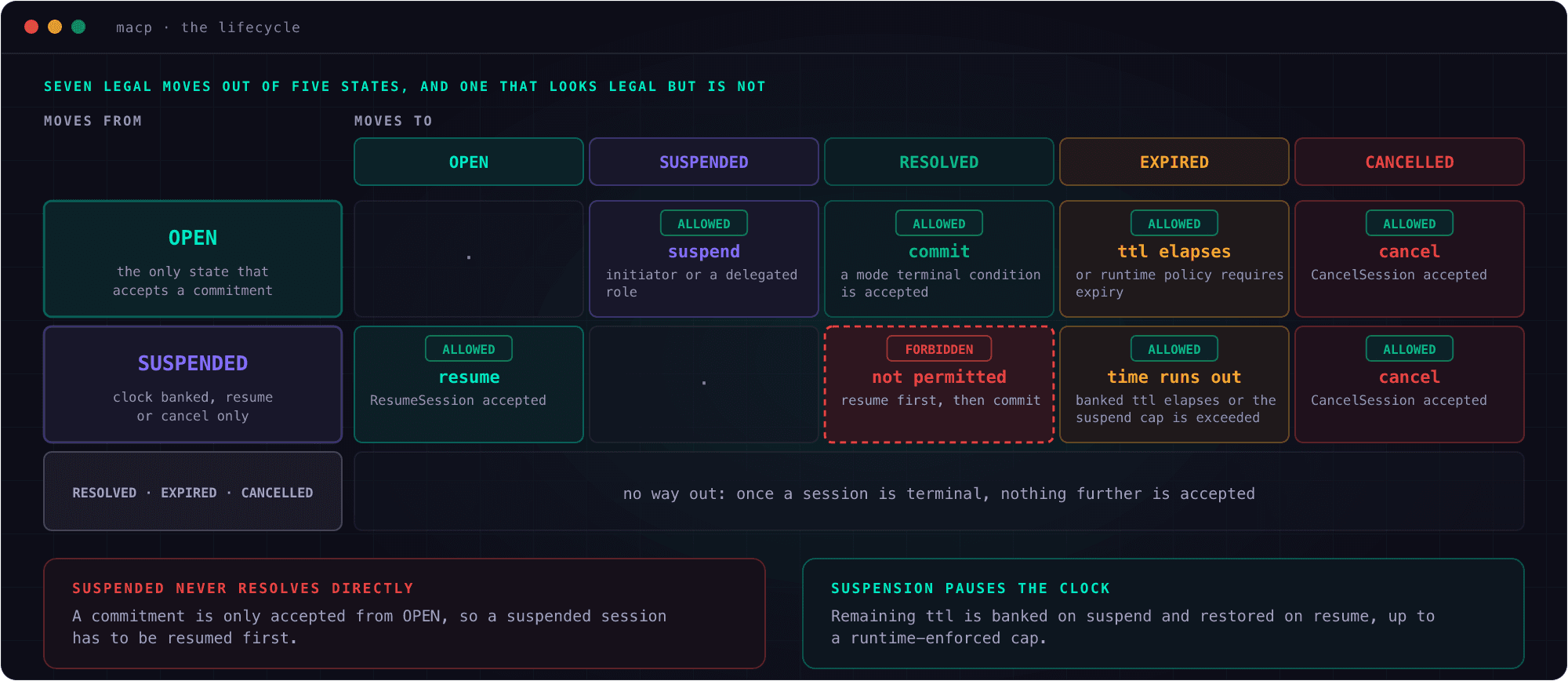 The seven permitted transitions of RFC-MACP-0001 section 7.2, with the one that is deliberately absent.
Between those five states there are exactly seven legal moves. An OPEN session can be suspended, resolved, expired or cancelled. A SUSPENDED session can be resumed, expired or cancelled.
The move that is not there
Look at the table again. A suspended session cannot go straight to RESOLVED.
This surprises people, because it seems harmless. If everyone has agreed, why not let the commitment through while the session is paused? The answer is that a commitment is accepted only from OPEN. A pause means "nothing binding happens now." If a commitment could land on a suspended session, the pause would mean nothing. So the rule is simple: resume first, then commit.
Suspension has a second detail that matters for replay. When a session is suspended, its remaining time is banked, and when it is resumed, the deadline is set to the resume time plus what was banked. A suspended session does not expire on its old deadline. To stop sessions from being parked forever, the runtime enforces a cap on total suspended time. The cap is fixed when the session starts and recorded with it, so replaying the session later uses the same cap, not whatever the runtime happens to be configured with that day.
What this gives you
Put the transcript and the state table together and you have the whole contract. A session starts on purpose, with a roster, a time limit and pinned rules. It accepts only legal messages from declared participants. It ends exactly once. And everything that happened in between is a record you can read, hand over, or replay.
If you want to read the normative text, the lifecycle is in the core RFC, Decision Mode has its own RFC, and the lifecycle page in the docs is the gentler version. The modes page covers the other four modes.
Next: how that final Commitment becomes something anyone can check, without trusting the system that produced it.